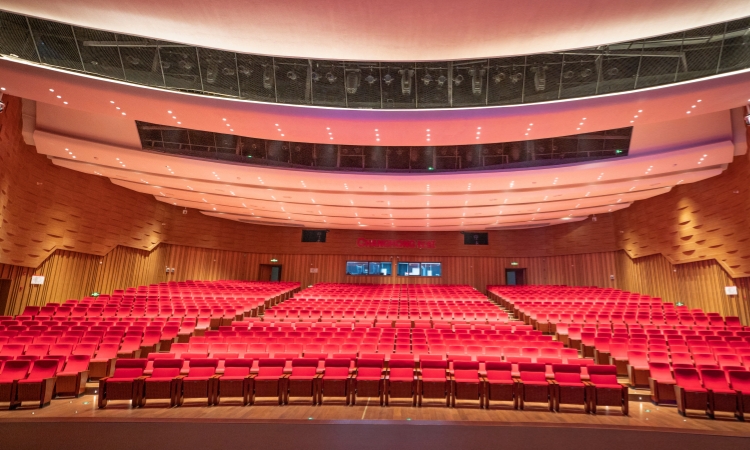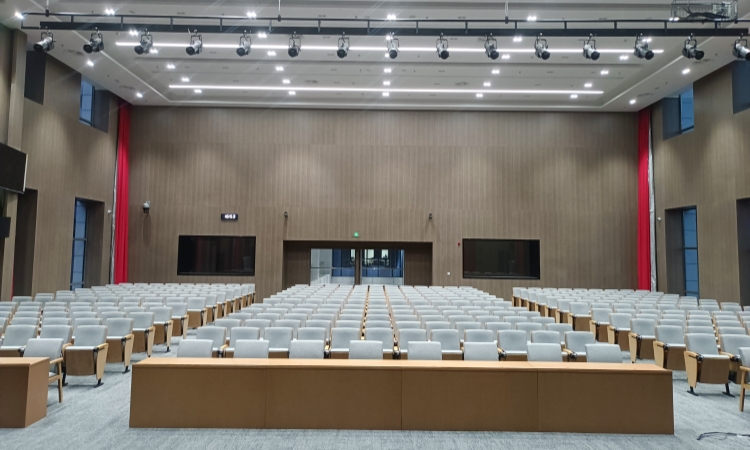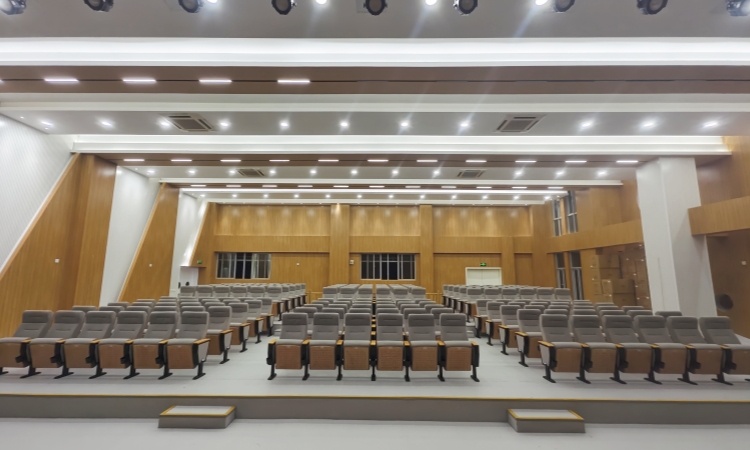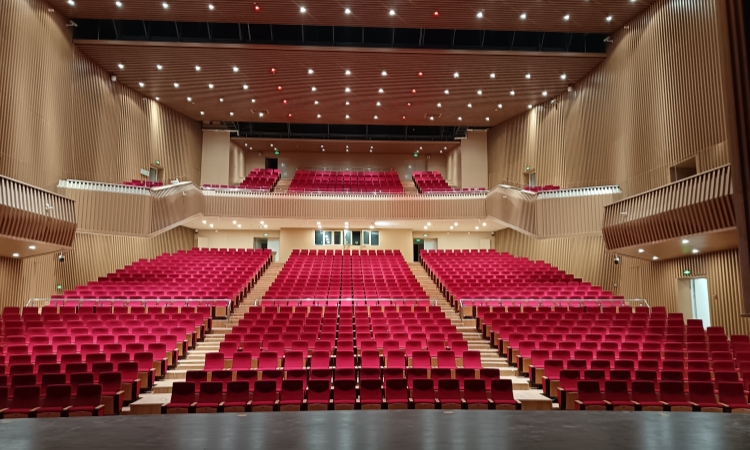


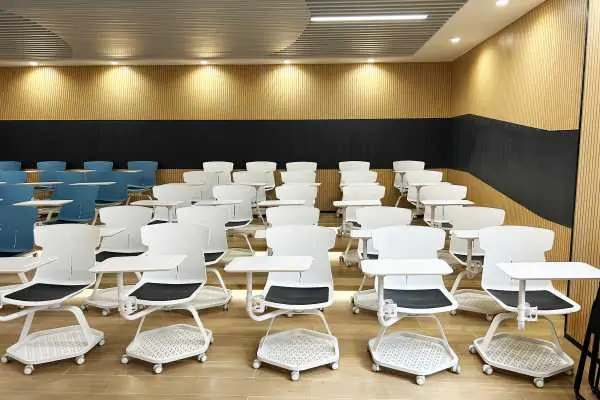
In school lecture halls, corporate auditoriums, or large conference rooms, lecture seating (also known as auditorium chairs or lecture hall chairs) endures heavy, daily usage. To determine whether a public seating manufacturer is truly conscientious, there is no need to consult their brochures—simply focus on five key craftsmanship details, and the quality—good or bad—will become immediately apparent.
1. Does the Flip-Up Writing Tablet Feature "Damping"?
This is the most intuitive test point. A high-quality lecture chair *must* have its flip-up writing tablet equipped with a hydraulic damping mechanism. When you lift the writing tablet and let go, a premium product will descend slowly, quietly, and automatically; conversely, a tablet lacking damping will slam down with a loud "thwack." This not only creates jarring noise but also inevitably leads to looseness, misalignment, or even finger injuries within six months. Furthermore, the edges of the writing tablet should be rounded or fitted with protective rubber edging to eliminate any burrs—a fundamental standard of care for any conscientious manufacturer.
2. Seat Cushion Resilience and Quick-Release Design
Lift the seat cushion to inspect its interior. Reliable auditorium chairs utilize a gravity-adaptive spring system paired with silent bearings, ensuring noiseless operation when sitting down or standing up, as well as uniform resilience. Even more critical is the quick-release seat cushion feature: the cushion should be removable by hand, facilitating deep cleaning and easy replacement. Inferior products, on the other hand, rely on a simple torsion spring that becomes weak and prone to jamming after just a few months; additionally, the cushion mounting screws are prone to stripping, leading to prohibitively high maintenance costs down the road.
3. Chair Legs and Anti-Loosening Screw Treatment
Turn the chair over to examine its underside. A conscientious manufacturer produces fixed chair legs via a single-piece die-casting process using aluminum alloy, resulting in a smooth base free of visible weld points. Furthermore, all floor-mounting screw holes are pre-treated with anti-loosening adhesive or fitted with nylon self-locking nuts. In contrast, cheap chair legs are typically constructed from welded iron plates that are merely spray-painted over; the weld points are rough, and within six months, rust will appear, screws will loosen, and the entire row of chairs will begin to wobble and rattle.
4. Foam Density and Fabric Labeling
High-quality lecture hall seating utilizes high-density cold-foamed polyurethane foam (with a density of ≥ 45 kg/m³). When compressed, it rebounds quickly and completely, leaving no lasting indentations. The fabric must possess stain-resistant and flame-retardant properties, and its reverse side should bear clear markings—such as an abrasion resistance rating (≥ 50,000 cycles). Products lacking such markings are often low-quality workshop-produced goods, offering no guarantees regarding either durability or safety.
5. Armrest End Caps and Dust-Proof Base Covers
High-quality products feature wear-resistant soft rubber caps fitted over the metal ends of the armrests to prevent bumps and scrapes; furthermore, the underside of the seat is equipped with a fully enclosed dust cover to prevent debris from entering the swivel mechanism. While the cost of these small components is negligible, they can significantly extend the product's lifespan—only manufacturers willing to invest in these "unseen details" can truly be considered conscientious.
Summary: When selecting lecture hall seating, keep these five keywords in mind: "dampened writing tablets, quick-release seat cushions, cast aluminum anti-loosening screws, high-density foam, and dust-proof base covers." Armed with this checklist, you will be able to tell at a glance whether a public seating manufacturer is truly committed to quality and integrity.