

Have you ever noticed the stark difference in student focus and engagement between a cramped, cluttered classroom and a bright, flexible one?
Education is shifting from a teacher-centered to a learner-centered approach, and classroom space design is a silent but crucial driver of this transformation. Student desks and chairs are no longer static furnishings, but adjustable, combinable, and interactive learning partners.
1. Why is "tailor-made" necessary? — The three major values of customized desks and chairs.
· A revolution in space efficiency: Traditional fixed desks and chairs often create "dead corners," while customized solutions, through "modular combination," allow every square meter to participate in teaching. For example:
Trapezoidal tables can be assembled into hexagonal collaboration islands or quickly reverted to lecture mode; folding tabletops along the wall transform corners into group discussion areas or quiet reading nooks.
• Invisible Protection for Health and Focus
Data shows that ergonomically designed desks and chairs can reduce classroom fatigue by 35%. Customization means:
Adjusting desk and chair height and backrest curvature according to student age groups;
Providing desks with adjustable tabletop angles for students with special needs, protecting their spine and eyesight.
• Seamless Switching Between Teaching Scenarios
The classroom of the future needs to quickly switch between "lecturing, collaboration, practice, and presentation." For example:
Laboratory classrooms use corrosion-resistant materials and embed power and sensor interfaces; Art classrooms are equipped with height-adjustable easel tables to prevent paint smudges.
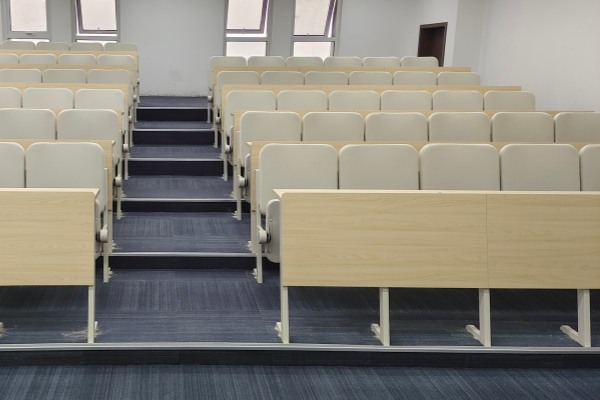
2. How to Customize Student Desks and Chairs Based on Classroom Size and Purpose?
The needs of different spaces are actually very clear:
• Standard Classrooms (Standard Teaching)
Primarily durable, stable, and conforming to standard student desk and chair dimensions.
Suitable for: Student desks and chairs of uniform specifications, classic styles, and ergonomic designs.
• Training institutions and small-class teaching:
Spaces are typically limited, requiring:
Narrower desktops
Movable or modular training desks and chairs
Minimizing floor space
The goal is to make every corner usable.
• Multifunctional classrooms and activity rooms:
More emphasis is placed on flexibility:
Movable desks and chairs with casters
Foldable and modular desktops
The ability to quickly adjust the layout according to the course content
These pieces of furniture allow for multiple uses of the space, improving efficiency.
In short, educational spaces are not appendages to buildings, but rather "third teachers." When desks and chairs begin to respond to children's height, the logic of the course, and the teacher's creativity, the classroom transforms from a "standard workshop" into an "ecosystem for growing minds."